guides
Fence Removal Cost in Northern Indiana: Tear-Out Guide
Fence removal in Northern Indiana runs $3 to $6 per linear foot for a basic tear-out, more when concrete footings and heavy haul-away are involved.
Installed aluminum fence in Northern Indiana runs $28 to $45 per linear foot for residential and pool grade in 2026, and $45 to $72 for commercial grade. The number moves on wall thickness, rail count, height, and gate count, not just style.
I’ve set aluminum posts in Kosciusko County clay for 15 years, on backyard pool surrounds in Warsaw, ornamental front-yard runs in Syracuse, and commercial perimeter jobs near Mishawaka. It’s the material homeowners reach for once they’ve decided they don’t want to block a view, and the one code inspectors sign off on fastest.
This guide breaks down what you’re actually paying for at each grade. It covers the styles available and how the rails and pickets work. It also covers why aluminum has become the default fence around pools and lake lots in this part of the state. For the vinyl-versus-aluminum decision itself, our vinyl vs. aluminum comparison covers when each material fits.
The per-foot number depends almost entirely on which grade you’re buying, not the color or the brand name on the invoice. Here’s what we’re actually quoting this year across Kosciusko, Elkhart, St. Joseph, and Marshall counties.
| Grade | Wall thickness | Rails | Typical height | Installed cost per foot |
|---|---|---|---|---|
| Residential | ~0.4 in | 2 | 42 to 48 in | $28 to $38 |
| Pool / Estate | ~0.5 in | 3 | 48 to 60 in | $34 to $45 |
| Commercial | 0.6 to 0.8 in | 3 to 4 | 60 to 96 in | $45 to $72 |
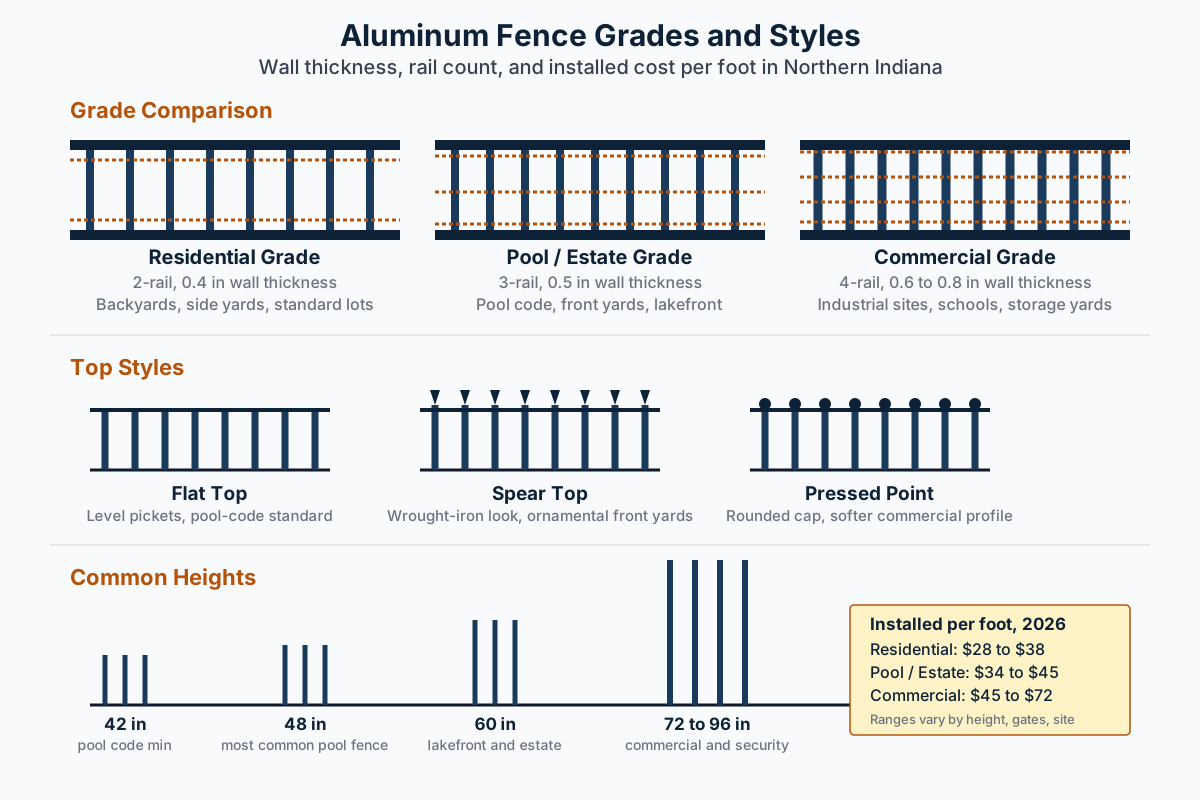
The diagram below shows the wall thickness and rail differences side by side, along with the height and style breakdown.
Take a typical 150-foot residential backyard job at pool grade, 48 inches, with one walk gate. That lands between $5,800 and $7,400 installed, once you add the gate, permit, and post footings. Anchor against that number for a standard Warsaw or Winona Lake backyard.
Every aluminum fence line starts with the same basic shape: hollow extruded aluminum pickets between posts, with horizontal rails running through them. What changes between grades is how thick the metal is and how many rails hold it up.
Residential grade runs about 0.4 inches of wall thickness on the picket, with two rails top and bottom. It’s built for the loads a residential yard actually sees, occasional lawn equipment contact, kids leaning on it, wind. It’s not built to stop a vehicle or take repeated commercial-site abuse, and it doesn’t need to be.
Pool and estate grade steps up to roughly 0.5 inches with a third rail added at mid-height. The extra rail does two things. It stiffens the panel so a 60-inch fence doesn’t flex or bow. It also closes the gap that would otherwise sit between top and bottom rails at pool-fence heights, which matters for climbability rules under barrier code. Our pool fence requirements guide covers the code specifics in full.
Commercial grade goes to 0.6 to 0.8 inch wall thickness with three or four rails, depending on height. We spec this for industrial sites, school perimeters, and storage yards near South Bend and Elkhart. Those fences need to survive decades of contact and hold a taller height without sagging between posts. Some also carry security add-ons like anti-climb spacing or a taller top rail.
The thickness isn’t a marketing number. Thin-wall aluminum at 60-plus inches, the corner some cut-rate quotes cut, will visibly bow between posts within a few years.
Rails are the horizontal bars that hold the vertical pickets in place and give the panel its rigidity. More rails mean a stiffer panel and a taller fence that stays straight.
Picket spacing on standard aluminum runs about 4 inches on center, which is code-compliant for most residential and pool applications. For yards with small dogs or toddlers, we add puppy pickets. These are extra half-height pickets set between the standard uprights near the bottom rail. They tighten the gap without changing the overall look from a distance. It’s a common add for anyone who’s had a dachshund find the one 4-inch gap in the yard.
Three top styles cover the vast majority of what we install. The diagram above shows all three next to each other.
Flat top. Level pickets with no ornamental point, the cleanest look and the standard for pool fencing where a plain, code-friendly profile is the goal. It’s also the least expensive to fabricate.
Spear top. Pointed pickets that read as the traditional wrought-iron look, common on ornamental front yards in older Goshen and Plymouth neighborhoods where the architecture calls for it. Spear top costs slightly more than flat because of the extra tooling on each picket.
Pressed point. A rounded, softer cap that splits the difference, common on commercial and institutional jobs where a spear top would look too residential and a flat top too plain. It shows up a lot on the commercial fencing side of our business.
Beyond the top style, panel style options include standard picket, puppy-picket, and flush-bottom panels for lots that need a tighter seal at grade. We stock the common styles and can special-order less common profiles with a longer lead time.
Nearly every aluminum fence we install is powder-coated black, bronze, or white. Powder coat is baked-on electrostatic paint, not a sprayed finish, and it’s a genuinely different product from wet paint on wrought iron.
That matters here specifically. Northern Indiana gets real freeze-thaw cycling, road salt spray near county roads, and humid lake-effect air off Barbee, Wawasee, and the smaller chains all winter. Wrought iron in that environment needs repainting every few years or it starts showing rust bloom at welds and joints. Powder-coated aluminum doesn’t rust at all, because there’s no iron in the base metal to rust. The coating’s job is holding color, not stopping corrosion, which is a much easier job.
We’ve got aluminum fence installed over a decade ago around Warsaw pool decks that still holds its original black finish with nothing done to it but a hose-down.
Lakefront lots rarely sit flat. Around the Barbee Lake chain and similar shoreline properties, the grade often drops several feet from the road to the water. A fence running perpendicular to that slope has to handle the change somehow.
Aluminum panels handle slope one of two ways. Racked panels pivot at the post connection so the picket line stays parallel to the ground, following the grade continuously in a smooth diagonal. Stepped panels stay level and drop in small increments between posts, like stair steps.
Racking is the more common pick on lakefront runs because it keeps a clean, continuous sightline down toward the water instead of a staircase effect that draws the eye. It costs a bit more in fabrication and layout time. Each panel section on a raked run has to be measured and set individually, rather than dropped in as a standard unit. On a typical sloped lakefront perimeter, racking adds roughly 10 to 15 percent over a flat-lot install of the same length and grade.
Two things drive this, and they’re related. The first is view preservation. Open picket construction means you can see straight through the fence from any angle. That matters when the other side holds a pool you’re supervising from the kitchen window, or a lake view you bought the lot for. A solid privacy panel does the opposite job.
The second is code fit. Aluminum pool-grade panels are manufactured with barrier-code spacing and rail placement built in. Meeting Indiana’s pool fence requirements comes down to ordering the right product line, not custom-engineering anything. We cover the specific height, gap, and gate-hardware rules in our pool fence requirements guide, which is worth reading before you get a quote if you’re fencing a new pool.
For lakefront properties, the same logic applies to the view instead of the pool. A homeowner on Barbee or one of the smaller chains isn’t paying for waterfront acreage to look at a solid fence line. Aluminum defines the property boundary, meets whatever setback the lake association requires, and leaves the view alone.
Aluminum gates match the fence panel style, same picket spacing, same rail count, same finish, hung on heavier posts to carry the extra hardware weight. A standard 4-foot walk gate on residential grade runs $350 to $550 installed. Pool gates need self-closing hinges and a self-latching mechanism per code, which adds $100 to $200 over a standard gate.
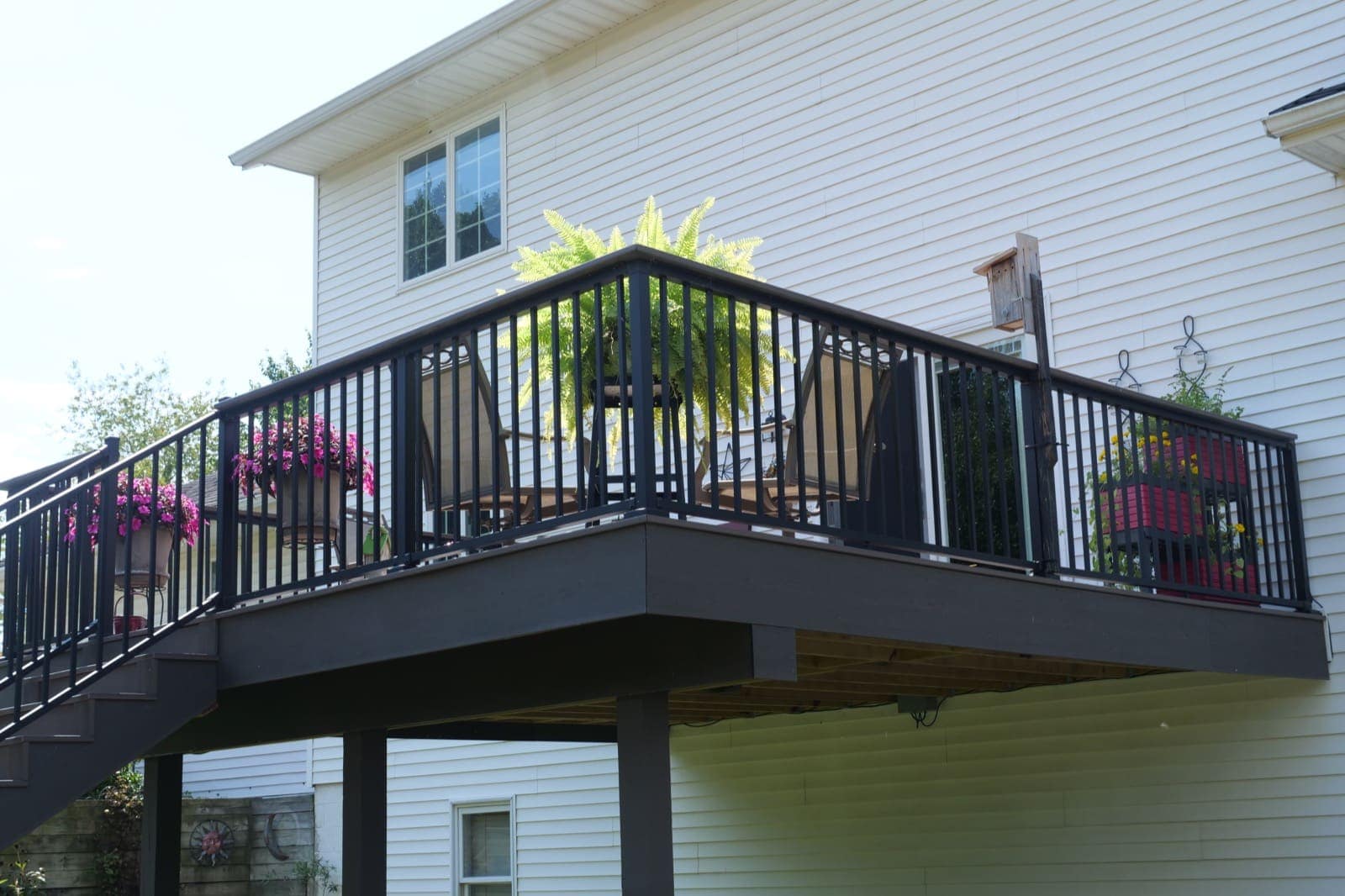
Plan for one more thing at the same time. If your project includes a deck, aluminum deck railing is manufactured in the same finish lines as aluminum fence. A black powder-coated fence around the yard and matching railing on the deck read as one continuous system, instead of two mismatched products. We spec this combination often on lakefront jobs where the deck and the yard fence are visible from the same sightline. Deck cost itself is a separate topic. Our deck cost guide for Warsaw breaks that down on its own.
Aluminum fence maintenance is close to nothing, which is most of the appeal once the install is paid for. A hose-down two or three times a year clears pollen, lake spray residue, and general dust. There’s no staining, no sealing, no repainting schedule.
The one thing worth checking annually is the gate hardware. A stiff self-closing pool gate hinge is a real problem, not a cosmetic one. So is a latch that isn’t fully engaging. Give gate swing and latch engagement a hand-check each spring.
Physical damage, a bent picket from a mower or a dented rail from a fallen branch, is repaired by swapping the damaged section. Aluminum panels bolt to posts, so a damaged panel comes out and a new one goes in without disturbing the rest of the fence.
Four things move an aluminum quote more than anything else:
Style choice, flat top versus spear versus pressed point, moves the number the least of any factor here, usually a few dollars per foot at most. Grade and height drive the budget, not style.
Want to see aluminum fence styles installed on real Northern Indiana properties before you commit to a look? Our project gallery has photos from recent jobs across the service area.
Residential-grade aluminum runs $28 to $38 per linear foot installed in 2026. Pool and estate grade with a heavier wall and a third rail runs $34 to $45. Commercial grade for industrial and institutional sites runs $45 to $72 depending on height and wall thickness.
Wall thickness and rail count. Residential grade uses a lighter gauge picket, usually around 0.4 inches, with two rails. Commercial grade steps up to 0.6 to 0.8 inch wall thickness with three or four rails. It’s built to hold a taller height without sagging on sites near Mishawaka and other commercial corridors.
No. Aluminum has no iron content, so it can’t rust the way wrought iron or steel does. The powder coat finish handles freeze-thaw cycling, road salt spray, and lake-effect humidity without the chipping or rust bloom that shows up on painted metal fence over the same years.
Puppy pickets are extra half-height pickets added between the standard uprights near the bottom rail, tightening the gap a small dog or a toddler could otherwise fit through. They’re common on pool fences and yards around Syracuse and other lake towns with small-breed dogs.
Yes, using racked panels that pivot at the post to follow the grade continuously, or stepped panels that stay level and drop in increments. Racking is the more common choice on lakefront lots around the Barbee Lake chain because it keeps a clean sightline down a slope. See our full lakefront fencing page for more on shoreline installs.
Aluminum is the more common pool fence material because the open picket design lets you see the pool from the house. Both materials can meet Indiana’s pool barrier code when installed correctly. For the full material comparison, see our vinyl vs. aluminum guide or check current vinyl fence pricing if you’re weighing both. Ready for a number on your property? Request a free estimate.
Fence removal in Northern Indiana runs $3 to $6 per linear foot for a basic tear-out, more when concrete footings and heavy haul-away are involved.
Real 2026 deck cost ranges for Warsaw, Indiana. Pressure-treated vs composite, railing options, footing depth, and what actually moves your price.
Installed chain-link in Northern Indiana runs $15 to $30 per foot residential, more for commercial. See what actually moves the number in 2026.
Contact Area Wide Fencing & Deck Supplies for a free on-site estimate in Northern Indiana.