comparisons
Postmaster Steel Fence Posts vs. Wood in Northern Indiana
Why we hide galvanized Postmaster steel posts inside wood and vinyl fences across Kosciusko and Elkhart counties, and when a wood post is still fine.
Field fence and woven wire are the same product. Two names for one thing. So there’s no choice to make between them. The choices that actually matter are the knot type, the wire gauge, the mesh spacing, the height, and how the corners get braced.
I’ve set posts in Marshall and Kosciusko County clay for 15 years, and the calls I get sound the same every spring: “I need field fence, but the guy at the farm store asked me hinge joint or fixed knot and I had no idea what he meant.” That confusion costs people money. Pick the wrong knot or the wrong mesh and the fence fails the first time a horse leans on it. Or the first time a goat sticks its head through.
This guide decodes the terminology for a 5 to 20 acre property with a few horses, some goats, and maybe chickens. It also covers where the DIY jobs we get called to fix usually go wrong. If you would rather hand the whole job off, our farm and field fencing page covers what we install and where we install it.
Woven wire fence is horizontal line wires held apart by vertical stay wires, knotted together at every crossing into a grid. Field fence, garden fence, horse fence, and no-climb fence are all woven wire. They differ by mesh spacing and knot style, and they’re sold under different names.
Nobody is choosing between “field fence” and “woven wire” the way you’d choose between vinyl and wood. You’re choosing a woven wire product with a specific mesh pattern for a specific animal.
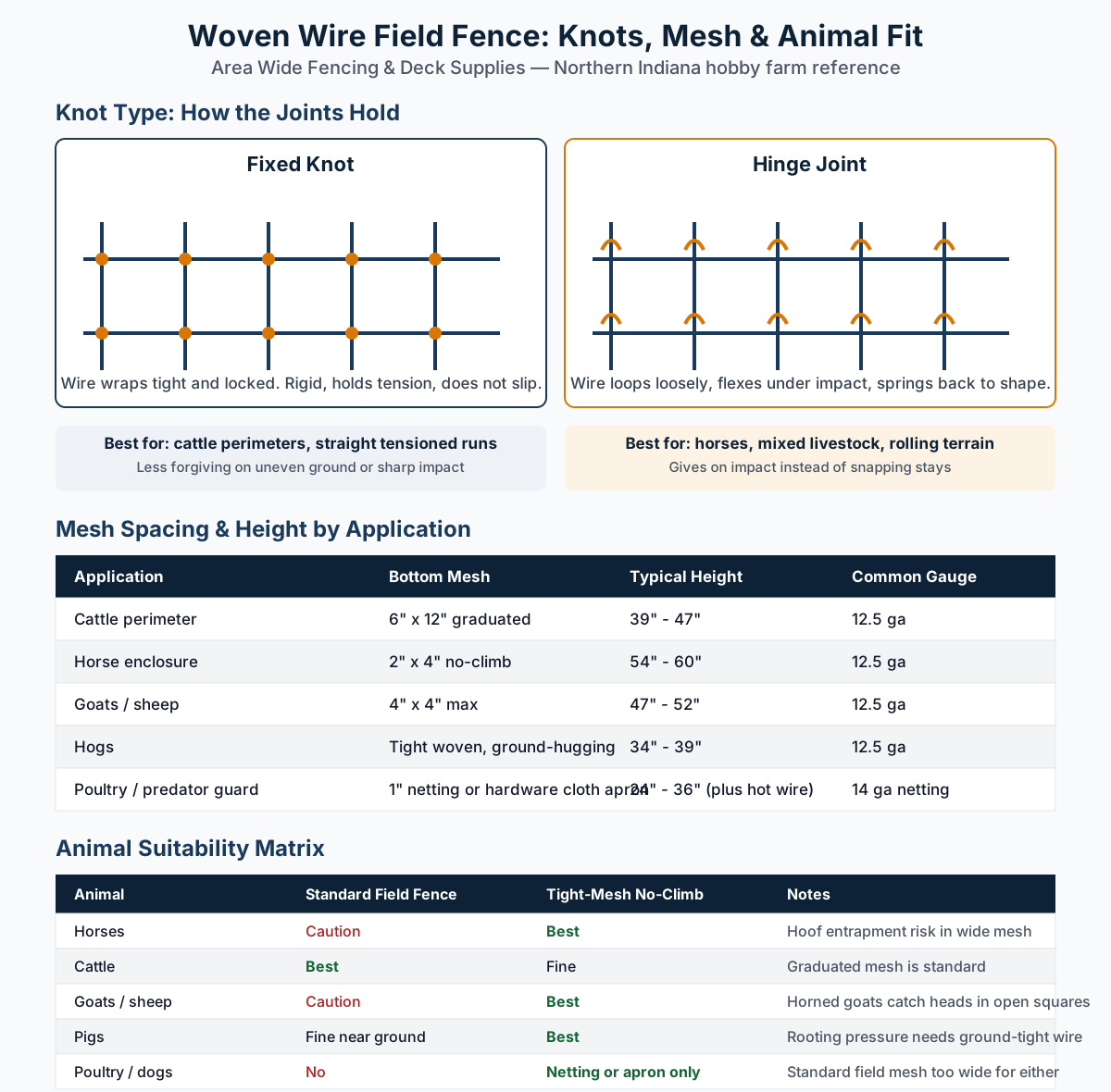
This is the first real fork in the road, and it’s the question most farm store clerks skip past. The image below shows how each knot behaves under pressure.
| Fixed Knot | Hinge Joint | |
|---|---|---|
| How it holds | Wire wraps tight, locked in place | Wire loops loosely, flexes on impact |
| Behavior under stress | Rigid, holds tension well | Gives, then springs back to shape |
| Best animals | Cattle | Horses, goats, sheep, mixed herds |
| Best terrain | Flat, straight runs | Rolling ground, uneven fence lines |
| Failure mode | Can bow or snap a stay if hit hard | Rarely fails from a single impact |
Cattle push against a fence with steady, even pressure, and fixed knot holds tension across a long straight run without loosening. Horses and goats hit a fence differently: sudden shoulder contact, a spooked bolt, a goat testing a weak spot daily. Hinge joint absorbs that kind of hit and springs back instead of bowing out of alignment.
If your hobby farm runs a mix, horses in one paddock and goats in another, go with hinge joint across the whole property. It costs a little more per roll. But it means fewer callbacks for us to reset a bowed section two years later.
Gauge numbers run backward from what people expect: the lower the number, the thicker the wire. 12.5 gauge is the heavier, stiffer wire; 14 gauge is thinner and lighter.
For perimeter fence around horses, cattle, goats, or sheep, 12.5 gauge is the standard we install. It resists bending when a 1,000-pound animal leans into it. It also holds up better against deer running a fence line at dusk, which is common on properties bordering woods around Culver and Knox.
14 gauge has its place: garden enclosures, chicken runs, or low-pressure boundary fence where nothing heavier than a dog is testing it. Skimping to 14 gauge around a horse paddock saves a few dollars a roll. It also gets you the fence we’re called to replace after one bad winter.
Mesh spacing is the single biggest factor in whether an animal gets contained safely or gets hurt trying. Height comes second, and the two numbers move together by species.
Barbed wire still shows up on hobby farm quotes, usually as one or two top strands added above woven wire on a cattle fence. That combination works because cattle respect the sting of a barb. The extra strands add height and a deterrent, and the woven wire underneath keeps doing the containment work.
Horses are a different story. Barbed wire on its own is a real injury risk. Horses don’t see the wire well, and they panic when they make contact. A spooked horse tangled in barbed wire can end up with cuts that need stitches or worse. I won’t run barbed wire as primary containment for a horse paddock.
Barbed wire is just as pointless on its own for goats and other small stock. The spacing is too wide to stop an animal that size from walking through or ducking under. Barbed wire does make sense in the rural corridor down toward Logansport. Bigger acreage and more cattle operations make a top strand over woven wire a common, sensible request there.
Every roll of woven wire ships with a zinc coating rated Class 1 or Class 3. Class 1 is the lighter, standard coating. Class 3 carries roughly triple the zinc weight for a modest cost bump.
In Marshall and Kosciusko County, fence wire sits wet from snowmelt for weeks and cycles through freeze and thaw dozens of times a winter. Class 3 earns the upcharge here. We’ve pulled Class 1 wire out of wet pasture corners rusted through in under 15 years. Class 3 in the same ground routinely runs 25 to 30.
Nine times out of ten, the ag fence job we get called to fix didn’t fail in the middle of the run. It failed at the corner. Woven wire gets stretched under real tension during install, and every pound of that tension pulls on the corner and gate posts. Those posts need a proper H-brace. An H-brace is a horizontal brace post set between two uprights, held square by a diagonal tension wire. Without one, the corner leans inward over a season or two and the fence line sags with it.
A single post set in a hole, even a deep one, cannot hold that load alone. The H-brace spreads the pull across two posts, which keeps a quarter-mile of tensioned wire from dragging its corners out of square. Line posts along the run sit 24 to 30 inches deep, spaced 10 to 16 feet apart. Corner and gate posts carry the whole system, so they go below the frost line, 36 to 42 inches. Set them in concrete if the ground stays wet. Tamp them in compacted lifts of native soil if it drains.
Low pasture south of Goshen and around county drains near Plymouth holds water most of the spring, which changes how posts get set. Driving a post into saturated ground looks easy and holds nothing. The post sits loose in waterlogged soil that gives it no resistance, and it gives way the first time an animal leans on the wire. In those spots we auger the hole, then tamp native soil back in around the post in compacted layers. It’s slower. But it’s the difference between a post that holds for 20 years and one that leans by next spring.
Coyotes are the working predator pressure here, and woven wire alone doesn’t fully stop one that’s motivated. They dig under a fence before they try to climb it, so the wire needs to run tight to the ground with no gap for a nose to work under.
For goat and sheep pens, burying the fence a few inches or adding a gravel apron closes that gap. Poultry need it even more, since a coyote or raccoon needs far less room to reach a chicken than a goat. A hot wire offset 6 to 8 inches off the ground adds a real deterrent. It’s a cheap add during install, and an expensive retrofit after a loss.
A roll of woven wire ag fence runs 330 feet. Standard 12.5 gauge field fence in common heights costs $180 to $260 a roll. Hinge joint no-climb horse fence, or heavier Class 3 product, runs $280 to $400. Fixed knot cattle fence sits at the lower end; hinge joint horse-rated fence sits at the upper end.
Fully installed woven wire fencing typically runs $4.50 to $9.00 per linear foot in our service area. That includes H-brace corners, proper post spacing, and a gate or two. Flat, dry, open pasture with wide post spacing lands at the low end. Wooded lot lines, wet ground, or several gates land at the high end. Chain-link fencing costs in Northern Indiana run on a different structure entirely, for backyard and commercial jobs.
Use this framework to decide between buying the materials yourself and having us run the whole install:
Every ag fence needs at least one gate wide enough for equipment. Most hobby farms need two or three: one for daily traffic, one wide enough for a truck and trailer or a mower. Gate posts carry the same load as corner posts, so they need the same H-brace treatment. Constant swinging stress loosens a weak post fast. Our farm and field gates page covers the widths and hardware we install most.
The hobby farm corridor runs through Plymouth, Culver, and out toward Knox. You’ll find tighter 5 to 10 acre horse and goat setups alongside 15 to 20 acre properties running cattle and chickens. Ground varies more than people expect over a short drive. It’s sandy and well-drained near some lake edges, then heavy clay and slow to dry closer to the Yellow River bottoms.
Properties south of Goshen run similar patterns: smaller acreage, mixed animals, and enough tree cover that deer pressure is a real design factor. We spec gauge and post spacing with that in mind, rather than defaulting to whatever the closest farm store has in stock.
Plenty of hobby farms run wood fencing along the road frontage for looks, with railroad tie entries at the drive. Then woven wire everywhere else for actual containment. If you’ve also got a dog needing its own run separate from the pasture, that’s a different mesh and height problem. Our guide on the best fence for dogs in Northern Indiana covers it.
Yes. Field fence is a type of woven wire fence, horizontal and vertical wires knotted together into a grid. There’s no separate “field fence” product competing with “woven wire.” The real decisions are knot type, wire gauge, mesh spacing, and height for your specific animals.
Fixed knot wraps wire tight at every intersection and holds tension rigidly, which suits straight cattle runs. Hinge joint uses a looser loop that flexes under impact and springs back, which works better for horses, goats, and mixed herds on uneven ground.
12.5 gauge is the standard for perimeter fence around horses, cattle, goats, and sheep. It resists bending under animal pressure and deer impact far better than 14 gauge, which suits lower-pressure garden or poultry enclosures instead.
Line posts typically go 24 to 30 inches deep. Corner and gate posts anchoring an H-brace need to sit below the local frost line, 36 to 42 inches. Set them in concrete in wet ground, or tamped native soil where drainage is better.
Goats need mesh no wider than 4 by 4 inches so horned animals can’t get their heads stuck. That same tight spacing helps at ground level against coyotes, though a buried wire apron or hot wire offset does most of the real predator work.
Installed woven wire fencing with proper H-brace corners typically runs $4.50 to $9.00 per linear foot depending on terrain, post spacing, and gate count. Rolls alone run $180 to $400 depending on height, gauge, and knot type for DIY buyers working from our wholesale supply counter.
Barbed wire works as a top-strand addition on woven wire for cattle, not as a standalone containment fence. It’s genuinely dangerous for horses. They don’t see it well, and they can be badly cut if they get tangled in it. It also does nothing to hold goats or other small stock, which need a solid mesh barrier. It shows up most in the rural corridor toward Logansport, where bigger acreage and cattle operations make that combination a practical choice.
Why we hide galvanized Postmaster steel posts inside wood and vinyl fences across Kosciusko and Elkhart counties, and when a wood post is still fine.
Compare vinyl and aluminum fencing for privacy, pool code, lake views, pets, curb appeal, and maintenance.
Compare pergolas and gazebos for Northern Indiana yards, including shelter, cost, permits, and everyday use.
Contact Area Wide Fencing & Deck Supplies for a free on-site estimate in Northern Indiana.